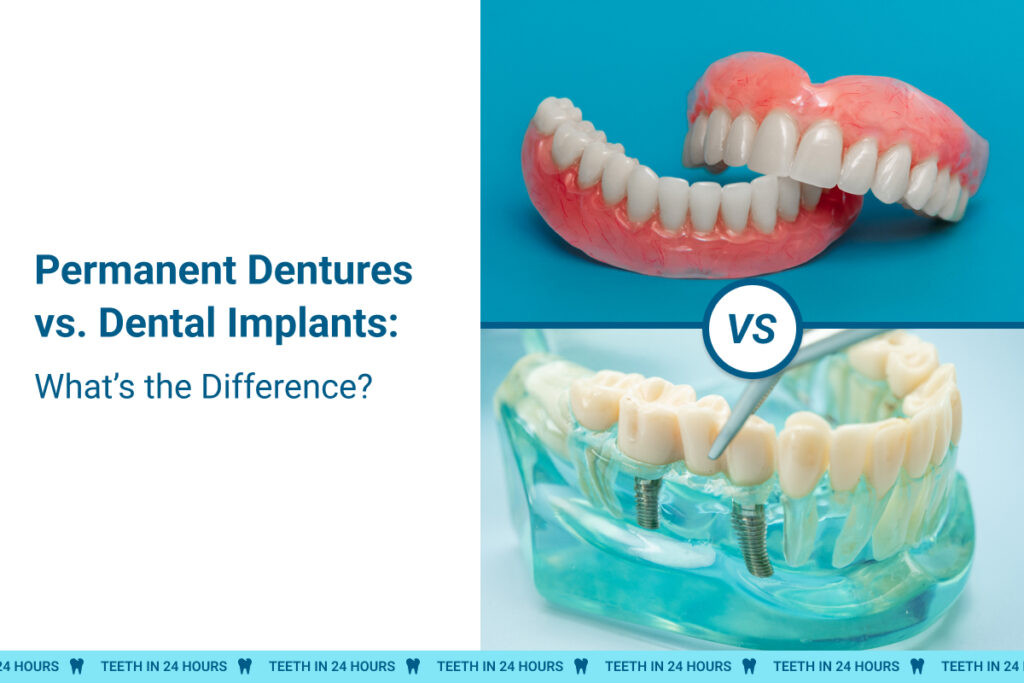
What’s the Difference?
If you’re comparing permanent dentures and dental implants, you may be wondering whether they are two different treatments or different names for the same thing.
In many cases, “permanent dentures” is a plain-language or colloquial term that patients use when talking about dental implants, implant-supported dentures, same-day teeth, or a full-mouth implant solution. The exact treatment can vary, but the basic idea is the same: using dental implants to create a stronger, more stable foundation for replacement teeth.
Dental implants are the foundation. Permanent dentures or full-arch restorations are the replacement teeth that those implants may support.
At Dr. Lampee’s office, patients may have options that include dental implants, implant-supported dentures, full-mouth dental implants, and Teeth In 24™ for qualifying patients.
What Are Dental Implants?
Dental implants are small titanium or ceramic posts that are surgically placed into the jawbone to replace the roots of missing teeth. They provide a strong, permanent foundation for crowns, bridges, or full-arch restorations.
When placed by a skilled dental implant specialist, dental implants are designed to look and function like natural teeth. They can be used to replace one tooth, several teeth, or a full arch of missing or failing teeth.
For full-mouth restoration, Dr. Lampee’s implant approach may use 4–6 titanium implants per arch. These implants help support a full set of replacement teeth, creating a stable foundation for same-day provisional teeth and, later, a final restoration.
Dental implants may be used to support:
- Single crowns
- Full mouth restorations
- Same-day provisional teeth
- Final restorations
For many patients, dental implants are considered because they offer more stability than traditional removable dentures.
What Are Permanent Dentures?
“Permanent dentures” is not always a precise clinical term. Many patients use it to describe replacement teeth that feel more secure than traditional dentures because they are supported by dental implants.
Depending on the treatment plan, permanent dentures may refer to:
- Implant-supported dentures
- Fixed full-arch teeth
- Same-day temporary teeth
- Full-mouth dental implant restorations
- Teeth supported by 4–6 implants per arch
Traditional dentures sit on top of the gums and are removable. “Permanent dentures” or implant-supported options are different because they use dental implants for support.
Some implant-supported dentures are removable for cleaning. Others are fixed in place and are only removed by a dental professional. The right option depends on your oral health, jawbone support, bite, goals, and treatment plan.
How Are Permanent Dentures and Dental Implants Connected?
Permanent dentures and dental implants are closely connected because implants often act as the foundation for the denture or full-arch restoration.
Think of it this way:
- Dental implants replace the roots of missing teeth.
- Permanent dentures or full-arch restorations replace the visible teeth.
The implants support the replacement teeth, helping create better stability than traditional dentures.
In a full-mouth implant treatment plan, Dr. Lampee may place implants and secure a temporary set of teeth as part of the same-day process. After healing and final planning, the temporary teeth are later replaced with a final restoration.
This means the process may include:
- Failing teeth removed, if needed
- Dental implants placed
- Temporary teeth secured
- Healing and follow-up
- Final teeth placed
This is why patients may describe the result as “permanent dentures,” even though the treatment is built around dental implants.
What Is Teeth In 24™?
Teeth In 24™ is a same-day dental implant solution developed by Dr. Lampee. It allows most patients to have failing teeth removed, implants placed, and temporary teeth secured, all in just one visit.
This approach is designed for patients who need fast, long-lasting full-mouth restoration and want a more stable alternative to missing teeth or traditional dentures.
With Teeth In 24™, patients may receive a fixed temporary restoration first. This same-day restoration is typically made from PMMA, which is used during the healing and transition phase. The final restoration is made from zirconia.
Not every patient has the same treatment needs, so a consultation is the best way to determine whether Teeth In 24™ or another dental implant option is appropriate.
Fixed vs. Removable Implant-Supported Dentures
One reason the term “permanent dentures” can be confusing is that implant-supported dentures can be either fixed or removable.
Fixed Implant-Supported Dentures
Fixed implant-supported dentures stay in place and are not removed daily by the patient. They are supported by dental implants and are designed to feel stable while eating, speaking, and smiling.
A fixed full-arch restoration may be a good option for patients who want replacement teeth that feel more secure than traditional removable dentures.
Removable Implant-Supported Dentures
Removable implant-supported dentures also connect to dental implants, but they can be taken out for cleaning. These may still offer more support than traditional dentures because the implants help reduce movement.
This option may be considered for patients who want more stability than traditional dentures but still prefer or need a removable appliance.
Which One Is Better?
There is no single best option for everyone. Some patients want fixed teeth. Others may be better suited for a removable implant-supported denture. Your oral health, jawbone support, goals, and treatment plan all matter.
What If You Have Bone Loss?
Some patients worry they are not candidates for dental implants because they have been told they have bone loss.
Bone loss does not always mean dental implants are impossible. Advanced techniques, including zygomatic implants and angled implant options, may still make implant treatment possible for some patients.
Dr. Lampee uses advanced 3D CBCT imaging for precision planning. This imaging helps evaluate the jawbone, anatomy, and treatment options before implant placement.
For patients with bone loss, treatment planning may include:
- Evaluating available bone
- Reviewing implant position and angle
- Considering zygomatic implant options
- Considering angled implant placement
- Planning the number of implants needed
- Determining whether a full-arch restoration is possible
A consultation with a dental implant specialist is the best way to find out whether you may still be eligible.
Which Option May Be Right for You?
The right option depends on your oral health, jawbone support, goals, and whether you are missing one tooth, several teeth, or most of your teeth.
You may want to ask about dental implants or permanent dentures if you:
- Are missing teeth
- Have failing teeth
- Wear traditional dentures
- Feel frustrated by loose dentures
- Want a more stable tooth replacement option
- Need full-mouth restoration
- Have been told you have bone loss
Most healthy adults who are missing teeth or wearing dentures are candidates for dental implants. Even if you have bone loss, advanced techniques may still make treatment possible.
A consultation is the best way to know which option fits your needs.
Schedule a Consultation
You should consider scheduling a consultation if missing teeth, failing teeth, or loose dentures are affecting the way you eat, speak, or smile.
During your consultation, Dr. Lampee can evaluate your oral health, review your jawbone with advanced imaging, and explain which options may be appropriate. Depending on your needs, he may discuss dental implants, implant-supported dentures, full-mouth dental implants, Teeth In 24™, or other treatment options.
Dental implants are one of the most durable and reliable tooth replacement options available. When properly placed and maintained, they can last several decades or even a lifetime.
If you are not sure whether you need dental implants, permanent dentures, or another option, the first step is getting a clear evaluation.
FAQs About Permanent Dentures and Dental Implants
Are permanent dentures the same as dental implants?
Not exactly. Many patients use “permanent dentures” as a colloquial term for dental implants, implant-supported dentures, or full-mouth implant restorations. Dental implants are the posts placed in the jawbone. Permanent dentures or full-arch restorations are the replacement teeth supported by those implants.
Why do people call dental implants permanent dentures?
People often use the term “permanent dentures” because they are looking for teeth that feel more stable than traditional removable dentures. In many cases, they are referring to implant-supported teeth or full-mouth dental implant options.
Are permanent dentures fixed or removable?
They can be either. Some implant-supported dentures are removable for cleaning, while others are fixed in place and only removed by a dental professional.
What are same-day teeth?
Same-day teeth usually refer to temporary teeth that are secured after implants are placed. With Teeth In 24™, most patients can have failing teeth removed, implants placed, and temporary teeth secured in one visit.
What is the difference between temporary and final teeth?
In Dr. Lampee’s process, temporary same-day teeth are used. After healing and final planning, the final restoration is made from zirconia.
How many implants are used for full-mouth dental implants?
Dr. Lampee’s full-arch implant approach may use 4–6 titanium implants per arch, depending on the patient’s needs and treatment plan.
Can I get dental implants if I have bone loss?
Some patients with bone loss may still be eligible for dental implants. Advanced options such as zygomatic implants and angled implant placement may help some patients qualify. A consultation and 3D CBCT imaging are needed to evaluate your options.
How long do dental implants last?
When properly placed and maintained, dental implants can last several decades or even a lifetime. Long-term success depends on treatment planning, oral health, maintenance, and regular dental care.
How do I know which option is right for me?
A consultation with a dental implant specialist is the best way to determine which option may be right for you. Dr. Lampee can evaluate your oral health, jawbone support, bite, and goals before recommending a treatment plan.
Compare every option in one place: our permanent dentures guide breaks down fixed implant-supported teeth, snap-in overdentures, and removable dentures side by side: types, costs, cleaning, and who is a candidate, with the next step for each.